Around the Edge
Boundaries, circles and traces from the past

The Fairy Circle
I rarely watch Doctor Who these days.
Tom Baker regenerated and I never quite recovered.
That isn’t entirely true. I have dipped in and out over the years and rather enjoyed some of the recent episodes. One that stayed with me was titled 73 Yards.
It was a strange story.
The Doctor was hardly in it, which was not necessarily a bad thing. Most of the episode follows Ruby Sunday, the Doctor’s companion.
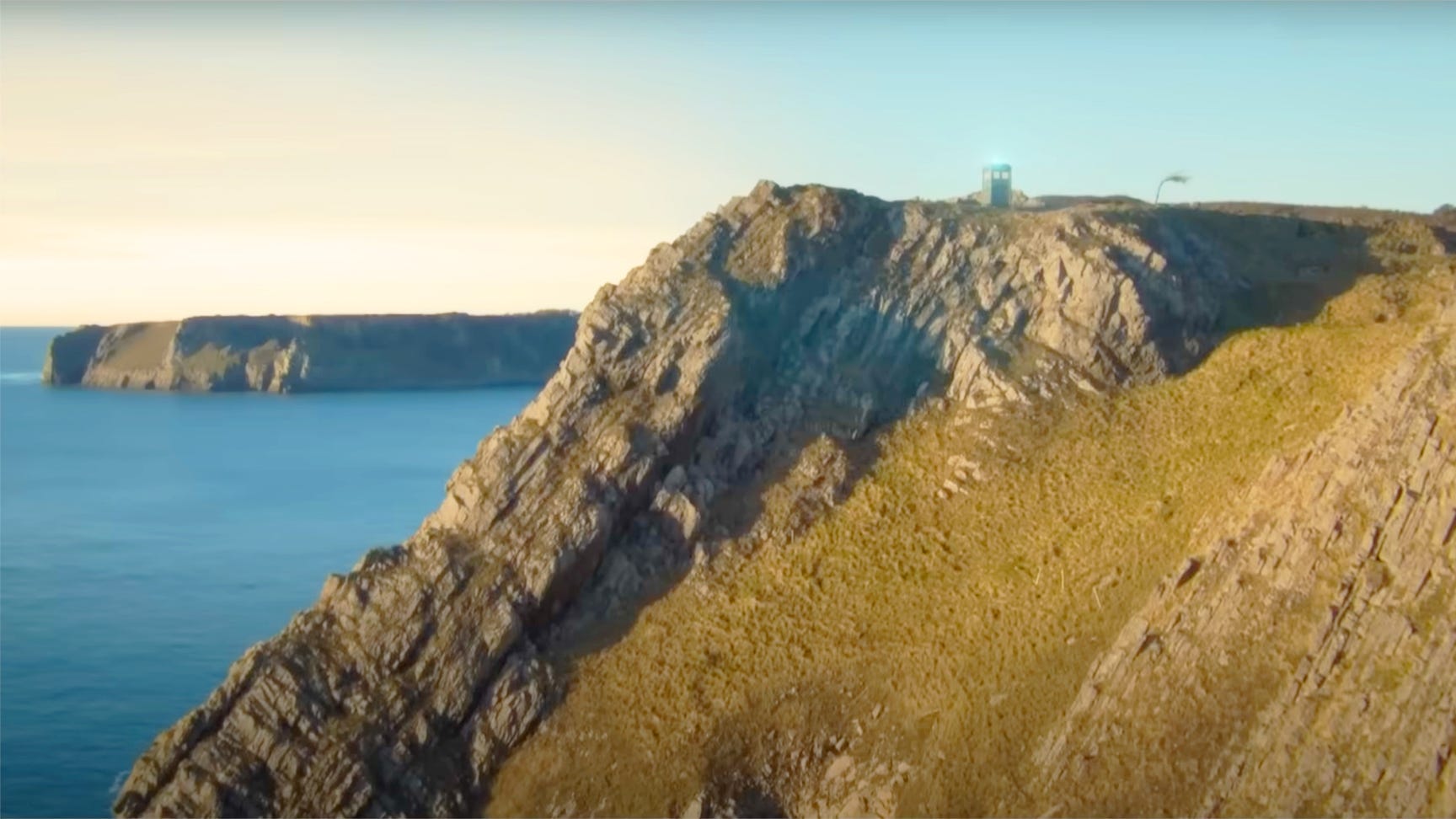
The episode begins on a beautiful Welsh cliff-top overlooking the sea. There, the Doctor disturbs a fairy circle and something goes wrong.
He disappears.
All that Ruby can see is an elderly woman standing exactly seventy-three yards away.
For the rest of Ruby’s life, the woman remains there.
Never nearer or further than seventy-three yards away.
The details are less important than the feeling.
What captured my interest at the start was not the woman.
It was the circle.
A fairy circle made from small objects left behind.
Bracelets.
Notes.
Tokens.
Little offerings.
Ordinary things gathered around a boundary.
Whoever created it had gone.
The circle remained.
What Remains
The older I get, the more interested I become in what survives.
Not just physically, but culturally.
A childhood memory survives.
A story survives.
A place survives, even after its buildings have disappeared.
An old photograph survives.
A song survives.
A family story survives.
Sometimes all that remains of a person is a name.
The strange thing is that human beings seem unable to stop leaving traces of themselves behind.
A note in a book.
A name scratched into a desk.
A letter.
A photograph.
A gravestone.
A social media post.
An archive box in a library.
A bracelet in a fairy circle.
Writing Along the Edge
This brings me to Ogham.
Ogham is the earliest known alphabet and writing system of Ireland. Most surviving examples are carved into standing stones.
What makes Ogham unusual is where it lives.
Most writing sits comfortably on a surface.
A page.
A wall.
A screen.
Ogham prefers an edge.
The inscriptions climb the corners of stones. Sometimes they travel up one side, across the top and down the other. The writing follows the boundary rather than occupying the face.
The edge becomes part of the message.
I’ve always found that strangely beautiful.
A writing system that inhabits a threshold.
Distinctions
Cybernetics often begins with a surprisingly simple act.
Draw a line.
That’s all.
One side becomes “this”.
The other becomes “that”.
A distinction has been made.
A system has appeared.
The coastline separates land from sea.
A fence separates field from forest.
A garden separates cultivated from wild.
A box separates inside from outside.
A fairy circle separates the ordinary from the strange.
Ogham does something similar.
The letters do not occupy the line.
They depend upon it.
Without the stem line there are no letters.
Without the boundary there is no distinction.
Without the distinction there is no information.
Perhaps this is why Ogham feels oddly modern despite its age.
The line comes first.
Meaning follows.
Lost Wood
Most scholars believe Ogham was originally written on wood.
If so, there is a problem.
Wood rarely survives thousands of years, especially in damp conditions.
The stones remain because stone is stubborn.
The wooden originals, if they existed, have almost entirely vanished.
This means we may only be seeing the monumental version of Ogham. The everyday wooden version may have disappeared long ago.
I often wonder what those lost objects looked like.
Wooden staffs.
Boundary markers.
Walking sticks.
Messages.
Records.
Perhaps entire traditions vanished with them.
The Wheel
One thought keeps returning to me.
A wheel has an edge.
A clear boundary between inside and outside.
A centre and a circumference.
A path that loops back upon itself.
Without an edge a wheel won’t work.
It becomes something else.
A ball.
I have no evidence whatsoever that Ogham was written on wheels.
None.
But it is a curious thing to imagine.
Most alphabets want a flat surface.
Ogham merely requires a line.
The stem line can run straight up a stone, along a piece of wood or, in theory, around a circle.
The script seems unusually comfortable with movement around a boundary.
Perhaps that is why it feels so natural when arranged as a circle.
Circles
There is something deeply human about circles.
Fairy circles.
Stone circles.
Wedding rings.
Clock faces.
Wheels.
Year wheels.
The circumference creates a path.
A journey.
A return.
A way of organising the world.
I first encountered the idea of arranging the twenty Ogham trees as a circle a few years ago. It immediately felt right. Not because there is evidence that ancient people did the same, but because the script itself seems unusually at home on a circle. Ogham feels less like writing spread across a surface and more like something travelling along an edge.
The line becomes a circle.
The journey becomes a cycle.
The edge becomes a path.
A Respect for Edges
Perhaps my fascination with edges has deeper roots.
Many years ago I found myself stranded on a cliff edge and had to be airlifted to safety.
It wasn’t a particularly mystical experience.
It was cold, snowing, inconvenient and rather embarrassing.
But it did leave me with a healthy respect for boundaries.
A few feet one way and you are standing on solid ground.
A few feet the other and you are not.
We tend to think of edges as abstractions.
The edge of a country.
The edge of a forest.
The edge of a map.
Yet edges are often where things change.
Where one thing becomes another.
Perhaps that is why they attract stories.
What Do People Leave Behind?
The fairy circle in 73 Yards was made from things left behind.
Small objects.
Small memories.
Small traces.
Ogham stones feel similar.
A name carved into stone.
A mark along an edge.
A message sent forward through time.
The person is gone.
The mark remains.
Perhaps that is all any of us ever do.
We leave traces.
We tell stories.
We plant seeds.
We put things into boxes.
We lose things.
We find things.
We draw lines around what matters.
And every now and then, centuries later, someone notices a mark along the edge of a stone and wonders who was here before them.
That seems a rather wonderful thing to leave behind.
I’ll leave it there.